Product Description
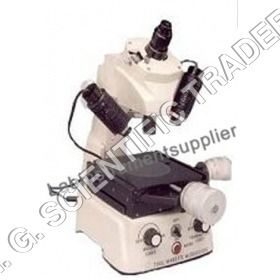
Description of Coaxial Microscope
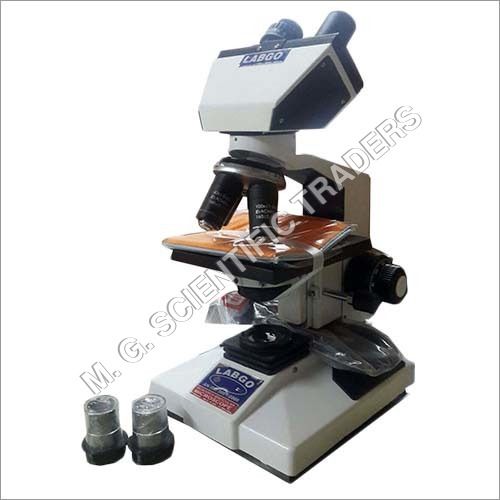
High quality Binocular Microscope for School, Colleges and Research Institutes.
Provided with a Trinocular head binocular observation inclined at 45degree,
with interpupillary distance 55 mm to 75 mm & diopter adjustments and a straight tube for photomicrography.
Rectangular 115 x 125 mm with co-axial mechanical stage.
Sub stage movable by rack and pinion Abbe Condenser of 1.25 N.A. with iris diaphragm and filter
Box type base with 6v-20w, variable halogen illumination.
Achromatic objectives: 4x, 10x, 40x, 100x(SL).
Eyepieces: 10x(pair) WF
Advanced Optical Clarity with Coaxial IlluminationHarnessing the principle of coaxial illumination, this microscope provides consistently bright and uniform lighting. The LED 3W light source with adjustable brightness and the Abbe NA 1.25 condenser deliver exceptional clarity even at high magnifications. Achromatic objectives and wide field eyepieces ensure distortion-free images, making critical observations reliable and detailed.
Ergonomic and Durable ConstructionBuilt from stainless steel and designed with an anti-vibration base, this microscope guarantees long-lasting durability and operational steadiness. Its ergonomic features include a trinocular projection head with a 30 inclined, 360 rotatable eyepiece tube and an adjustable interpupillary distance, promoting comfort during prolonged use in laboratory settings.
High-Resolution Imaging and ConnectivityEquipped with a high-sensitivity CMOS sensor and supporting resolutions up to 1920 x 1080 pixels, the microscope allows capturing crisp still images and videos in JPEG, BMP, or PNG formats. It features USB 2.0 and HDMI interfaces for convenient image transfer, supporting seamless integration into digital lab workflows.
FAQ's of Coaxial Microscope:
Q: How does the coaxial illumination system benefit microscopic observations?
A: The coaxial illumination system ensures that light is directed along the same optical axis as the observing lens, delivering bright, uniform illumination. This enhances contrast and clarity, especially for transparent or low-contrast specimens, making it easier to observe fine details.
Q: What are the main advantages of the microscope's rigid metallic frame and anti-vibration base?
A: The rigid metallic frame and anti-vibration base minimize operational vibrations, offering greater stability during use. This construction improves image sharpness and measurement accuracy, which is crucial for precise laboratory work where even minimal movement can affect results.
Q: When is this microscope particularly useful in laboratory settings?
A: This microscope excels in environments demanding high-resolution imaging, such as research, clinical diagnostics, and educational labs. Its ergonomic design and advanced optics make it suitable for extended observation sessions as well as detailed sample analysis.
Q: Where can the captured images and videos be transferred or displayed?
A: Captured images and videos can be saved in JPEG, BMP, or PNG formats and transferred through USB 2.0 to computers or directly displayed on monitors using the HDMI interface, enabling easy documentation and sharing of observations.
Q: What is the process to achieve accurate focusing on this model?
A: This microscope features coaxial coarse (30mm range) and fine adjustment (0.002mm precision) mechanisms. Users should begin with coarse focusing to bring the specimen into general view, then use fine focusing to achieve crisp, detailed images without overshooting delicate focal planes.
Q: How can users benefit from the ergonomic design of the trinocular projection head?
A: The trinocular projection head is inclined at 30 and rotatable 360, reducing neck and back strain during extended use. Its adjustable interpupillary distance (48mm-75mm) accommodates different users, ensuring comfortable, fatigue-free operation in shared laboratory environments.










 Send Inquiry

 Send Inquiry
 Send SMS