Product Description
Description of Anaerobic Culture Jar
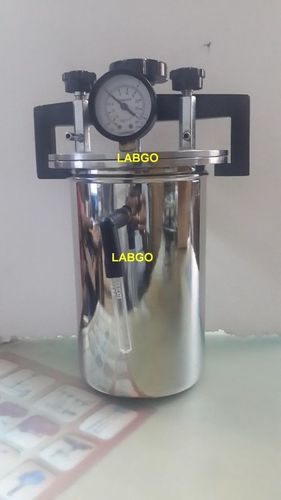
Anaerobic Culture Jar B.T.L.TYPE Modified mcintosh and fildes pattern, all metal construction consisting of a stainless steel jar with a top flange recessed for a torodial rubber sealing ring and a cover held in place by a strong bridge clamp. The cover is fitted with two needle valves for evacuation and a sachet containing a catalyst. A side arm on the jar is provided for connecting to semi solid Lucas indicator. The jar is supplied without semi solid Lucas indicator). With Pressure cum Vaccum Gauge.
High-Capacity Anaerobic CulturingDesigned with a 3.5-liter capacity, this anaerobic culture jar accommodates up to 12 standard Petri dishes, making it ideal for hospital and laboratory settings that require batch culturing of anaerobic organisms. Its cylindrical form factor ensures efficient space usage and simplified handling.
Durability Meets SafetyConstructed from premium stainless steel and plastic, the jar is both durable and easy to sterilize through standard autoclaving procedures. The leak-proof lid, sturdy clamps, and rubber gasket provide secure sealing, minimizing contamination risks during anaerobic cultivation.
Complete Manual OperationWith manual operation, there's no requirement for electrical power, ensuring uninterrupted use even in low-resource or remote settings. The air release valve and analog display facilitate straightforward monitoring and control of internal conditions.
FAQ's of Anaerobic Culture Jar:
Q: How is the Anaerobic Culture Jar used for cultivating anaerobic bacteria?
A: The jar is first loaded with up to 12 Petri dishes containing culture media, then sealed with the leak-proof lid, clamps, and rubber gasket. After adding the palladium catalyst and flushing with an appropriate gas mix, the air release valve is used to evacuate oxygen, establishing anaerobic conditions. The jar is then incubated at a suitable temperature, ranging from ambient up to 50C.
Q: What materials are used in the construction of this anaerobic culture jar?
A: This jar is made from high-quality stainless steel and plastic, ensuring both excellent durability and resistance to corrosion. The materials are carefully chosen to withstand repeated autoclaving for sterilization.
Q: When should the palladium catalyst be replaced or regenerated?
A: The palladium catalyst should be checked and replaced or regenerated if it shows reduced effectiveness in removing residual oxygen. Best practice is to inspect it regularly, especially after each sterilization cycle, to ensure optimal anaerobic conditions.
Q: Where is this product most commonly used?
A: This anaerobic culture jar is predominantly used in hospital microbiology laboratories, research institutions, and educational settings throughout India. Its sturdy design is well-suited for frequent and robust laboratory use.
Q: What are the main benefits of using this manual, analog display culture jar?
A: Key advantages include its power-free manual operation, reliable leak-proof construction, and the ability to autoclave for repeated use. The analog display allows for straightforward monitoring without complex electronics, ensuring simplicity and durability.
Q: How do you sterilize the jar before and after use?
A: The jar's materials allow it to be sterilized using a standard autoclave. Before use, dismantle and clean each component, then autoclave to ensure complete sterility. Repeat the process after each cultivation cycle to eliminate contaminants.












 Send Inquiry

 Send Inquiry
 Send SMS