Product Description
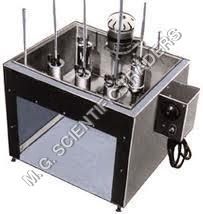
We a well-known manufacturer, exporter and supplier in the domain, engaged in offering excellent quality Carbon Residue Apparatus (Rams Bottom). Consists of a solid metal bath having 6 walls to accommodate cocking bulbs, this apparatus is widely used to determine the amount of carbon deposit when an oil is evaporated under specified condition. Under experts' visionary guidance, our provided apparatus is intricately manufactured by utilizing supreme quality components and high-end machines in conformity with the set market norms. We provide this Carbon Residue Apparatus (Rams Bottom) in different specified and customized options at pocket-friendly prices within given time frame.
Features:
-
Unmatchable performance
-
Low power consumption
-
Easy to operate
-
Precisely engineered
Technical Description:
It is used to determine the amount of Carbon deposit when an oil is evaporated under specified condition. The apparatus consists of a solid metal bath having 6 walls to accomodate cocking bulbs with heating elements around the bath the temperature which may be controlled by a Pyrometer depending upon the type supplied, 6 cocking bulbs are supplied with apparatus.
Reliable Carbon Residue MeasurementThe CRA-25 Carbon Residue Apparatus is purpose-built for laboratories seeking accurate, manual measurement of carbon residue in petroleum products. It aligns with ASTM D189 and IS:1448 industry benchmarks, ensuring dependable results across a temperature range up to 600C. With robust components and a corrosion-resistant finish, this apparatus is designed for long-term, effective use in laboratory settings.
Advanced Safety and User ControlSafety is prioritized with double-wall construction, an insulated outer case, and a built-in thermal fuse. Users benefit from controlled heating rates using the integrated regulator, while the special heat-resistant alloy crucible endures high temperatures. The analog thermocouple display provides real-time monitoring, enabling safer and more accurate operation for a wide range of researchers.
FAQ's of Carbon Residue Apparatus:
Q: How is the heating rate controlled in the CRA-25 Carbon Residue Apparatus?
A: The heating rate in the CRA-25 is controlled manually using an integrated regulator, allowing users to adjust the temperature as required for specific test protocols. This ensures precise adherence to ASTM D189 and IS:1448 standards.
Q: What safety features are included in this apparatus?
A: The apparatus features a thermal fuse and a double-wall insulated outer case to minimize the risk of overheating and protect users from accidental contact with hot surfaces, ensuring safe laboratory operation.
Q: Where can the CRA-25 Carbon Residue Apparatus be used?
A: The CRA-25 is designed for laboratory environments with ambient operating conditions between 5C and 40C and up to 90% relative humidity. Its sturdy construction makes it ideal for research, industrial, and educational laboratories.
Q: What process does the CRA-25 follow to determine carbon residue?
A: The sample is placed in a 25 ml heat-resistant alloy crucible and heated under controlled conditions. The analog thermocouple display allows precise monitoring up to 600C, and residue measurements are conducted in accordance with ASTM D189 or IS:1448 procedures.
Q: What benefits does the variable heating rate offer during testing?
A: Variable heating rate control enables tailored test conditions, improving accuracy and reproducibility of results. This flexibility is especially beneficial when assessing a range of petroleum samples requiring different heating profiles.
Q: When should the apparatus be cooled and how is it achieved?
A: After completing the test, the apparatus should be allowed to cool naturally using its air cooling base. Do not attempt to accelerate cooling with forced air or immersion, as this may damage the unit or compromise results.
Q: What materials are used in the construction of the CRA-25, and how does this benefit users?
A: The apparatus is built from corrosion-resistant plastic and metal materials, with a special heat-resistant alloy for the crucible. This combination ensures longevity, reliability, and minimal maintenance during frequent laboratory use.












 Send Inquiry

 Send Inquiry
 Send SMS