Product Description
Description of Metallurgical Microscope
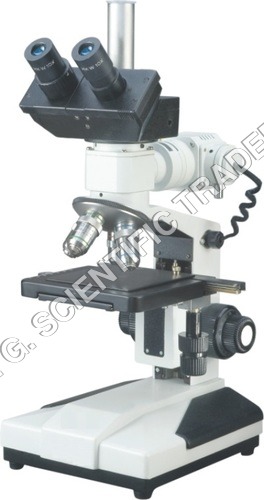
The Metallurgical Microscope that we offer is an essential for a dedicated study of Geography and Metallurgical related fields. The Metallurgical Microscope is equipped with all the necessary features and components to support easy operation. The Metallurgical Microscope offer high clarity results.
Specifications of Metallurgical Microscope:
AA Body : Trinocular Head inclined at 45-degrees.
AA Focussing : Both side co-axial focussing knobs.
AA Nosepiece : Quadruple revolving nosepiece with accurate centering & positive click stops.
AA Stage : Large Co-axial Mechanical Stage for X-Y movement of specimens.
AA Illumination : Brightfield vertical illuminator 6V-20W Halogen with field diaphragm, filter slots and bulb centring mechanism.
AA Objectives : Achromatic DIN M4X-M10X & M40X.
AA Eyepieces : H6X-WF10X-H16X (any two)
Features of Metallurgical Microscope:
AA Sturdy structure
AA Long service life
AA Precisely designed
AA Dust proof design
High-Precision Mechanical StageThe microscope is equipped with a double-layer mechanical stage, providing a spacious platform of 145 x 140 mm. Users can achieve smooth and controlled specimen movement along a 75 x 50 mm axis, allowing for meticulous sample positioning essential in metallurgical analysis. The robust design ensures stability and durability even with frequent laboratory use.
Versatile Imaging and Camera SupportThis instrument features a trinocular head with a dedicated camera port, enabling digital imaging with CMOS or CCD sensors. When outfitted with a suitable camera, users can capture still images in up to 1920 x 1080 pixel resolution and record full HD 1080p videos. USB or HDMI interface options permit easy connectivity for documentation and sharing of results.
Ergonomic and Adjustable for User ComfortDesigned with a 30 inclined, 360 rotatable head and adjustable interpupillary distance from 55 to 75 mm, the microscope accommodates users' comfort during prolonged use. The anti-fungal optics and rigid frame construction ensure clear, high-contrast images while sustaining long-term reliability in laboratory environments.
FAQ's of Metallurgical Microscope:
Q: How is sample focusing achieved on the metallurgical microscope?
A: The microscope provides coaxial coarse and fine focusing systems. Coarse adjustment offers a 30 mm range for rapid focus changes, and fine adjustment achieves 0.002 mm precision for critical detail observation, ensuring sharp imaging even at high magnifications.
Q: What types of samples and observations is this microscope suited for?
A: Specifically designed for metallurgical sample observation, the microscope utilizes reflected (incident) light theory, making it ideal for analyzing structural features, grain boundaries, and surface conditions of metals and alloys in laboratories.
Q: When should you use the camera port and which imaging formats are supported?
A: The camera port is utilized when digital imaging or video documentation is needed. With a compatible digital camera, you can capture images in JPG, BMP, or TIFF formats, and record 1080p full HD videos, supporting both research and report generation.
Q: Where can the microscope be installed and what are the recommended operating conditions?
A: This microscope is intended for laboratory environments and should be operated in temperature ranges between 10C and 40C. Ensure placement on a stable surface to support its 9 kg weight and provide access to an AC 220V/50Hz power supply.
Q: What are the main benefits of using this microscope for metallurgical analysis?
A: Users benefit from high-contrast optics, ergonomic handling, and digital imaging capabilities, facilitating comprehensive metallurgical studies. Its durable construction and anti-fungal optical components maximize performance and longevity in demanding laboratory settings.
Q: How do the magnification options enhance sample analysis?
A: Equipped with plan achromatic objectives (4X, 10X, 40X, 100X oil) and wide-field eyepieces, the microscope delivers magnifications from 50X up to 1000X. This range allows users to observe both macro structures and minute details in metal specimens clearly.












 Send Inquiry

 Send Inquiry
 Send SMS